France in the 1830s was struggling to recover from defeats and a new regime—the July Monarchy—was established. During this period, there was a desire to revive memories of battles and past glory, an idealized martial heritage based on victories and a greatness now lost.
In August 1844, France won its first military victory since 1815. It was in this political and martial atmosphere that the serial novel The Three Musketeers appeared in the newspaper Le Siècle, published between March 14 and July 14, 1844.
The Serial Novel
The Revolution of 1830 sparked, with a slight delay, a revolution in the press aimed at creating a new readership. Émile de Girardin, a businessman and journalist, had an idea: publish stories in several installments, with a preview of the next episode in the following issue.
In July 1836, two newspapers using this model were launched: La Presse and Le Siècle. These were sold at half the price of traditional newspapers. The Mysteries of Paris by Eugène Sue, serialized from June 1842 to October 1843, was a huge success. This novel firmly established the serialized novel as a major literary genre in the 19th century.
The Three Musketeers
It is highly likely that the historical foundation of the novel draws on Dumas’ research for Louis XIV and His Century (1844). The story devotes considerable attention to the history of the Queen’s diamond studs. Athos, Porthos, Aramis and d’Artagnan emerge from Courtilz de Sandras’s book. Dumas uses the near anonymity of these characters to shape the story so that their lives fit the plot. For example, he ages d’Artagnan.
Dumas inserts his characters into gaps left by history: for instance, the person who ensured the transfer between London and Paris when the studs were recovered is unknown, and so Dumas makes it d’Artagnan.
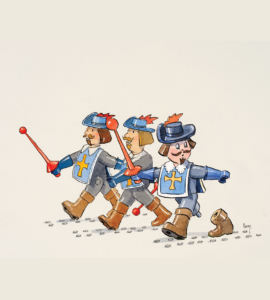
The four companions are depicted as brave, quarrelsome, indomitable and ready to do anything to protect the King’s interests. These traits have become inseparable from the popular image of musketeers.
D’Artagnan stands out, as the novel begins and ends with him. The narrative follows his journey from a young man barely out of adolescence to a respected and recognized adult. He is the one who ties the intrigues together and leads his companions in their adventures.
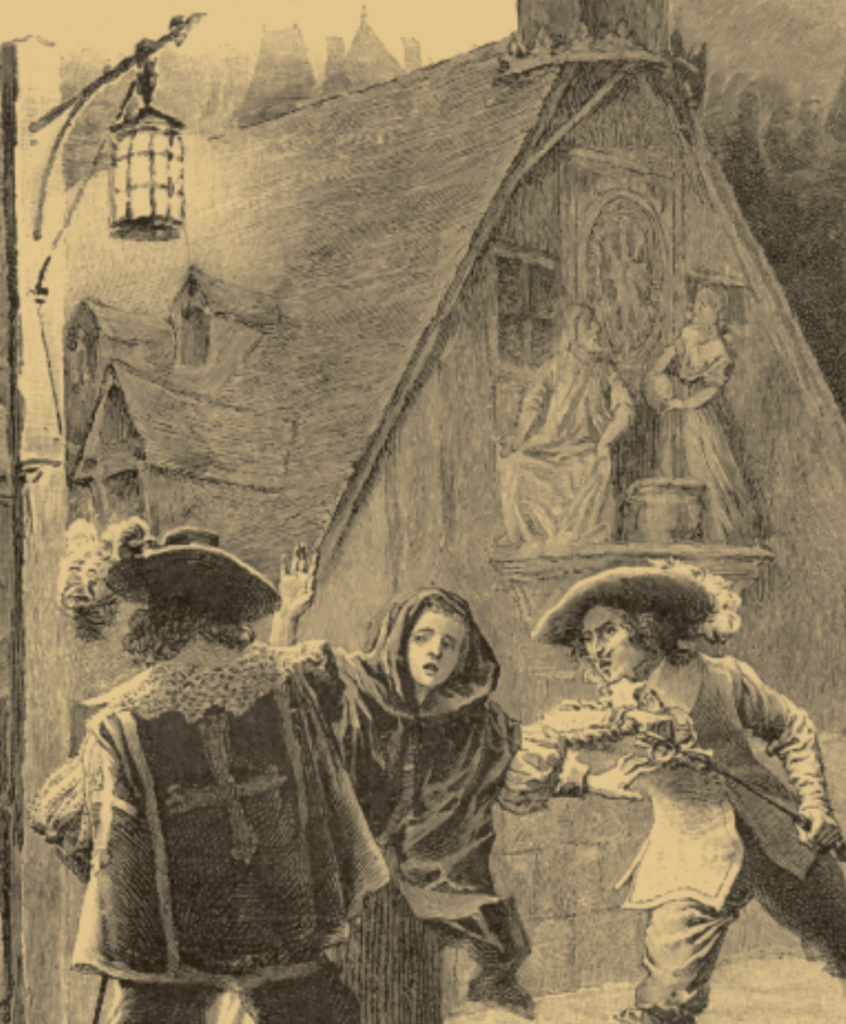
The novel was an immediate success and was published in book form in 1844, then reissued in 1846 with illustrations. It was exported abroad and translated into English as early as 1846.