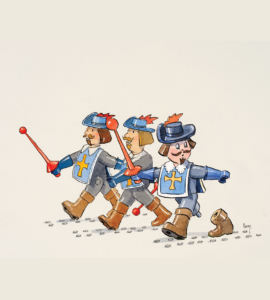

The Musketeers were among the first men in the French army to wear a uniform. Previously, soldiers distinguished themselves on the battlefield by painting a white cross or wearing a white scarf—the color of France—over their own clothing.
In 1622 the Musketeers received a blue cassock adorned with white fleur-de-lis crosses as their official uniform, worn over their personal clothes. The colour and crosses symbolized the King’s arms and authority. More than anything, this first uniform resembled a domestic livery, given that the Musketeers served the sovereign as guards, much like his valets. For this reason, it took more than a century for uniforms to become widespread in the French armies, as colonels refused to adopt attire that implied a domestic status.
Two Centuries of Evolution
The short cassock issued to the Musketeers was initially a simple four-flap coat, designed to protect the rider from rain. It ended at the waist but was lengthened around 1668 to reach the Musketeers’ knees. This change was introduced as a result of a shift in boot fashion, as the high, knee-length boots favored by Louis XIII gave way under Louis XIV to wider, lower boots cut below the knee, which meant that water that once ran off the cassock onto the boots now trickled into the boots themselves. However, this longer cassock proved cumbersome in battle, so musketeers often removed it so as to be able to charge more swiftly, despite the fact that without the cassock it was harder for enemies to identify them.
Around 1688 Louis XIV ordered the cassock to be replaced by a garment designed specially for the musketeers. The Musketeers wore this soubreveste—a sleeveless, more fitted vest fastened at the waist with clasps—until the corps was disbanded.
In the 1670s the King also mandated the wearing of a uniform beneath the cassock: for the musketeers, this was the red habit d’ordonnance, consisting of a coat, a vest and breeches. The red colour linked them to the King’s “Red House”, which included the Gendarmes and the Chevaux-légers, also dressed in red.