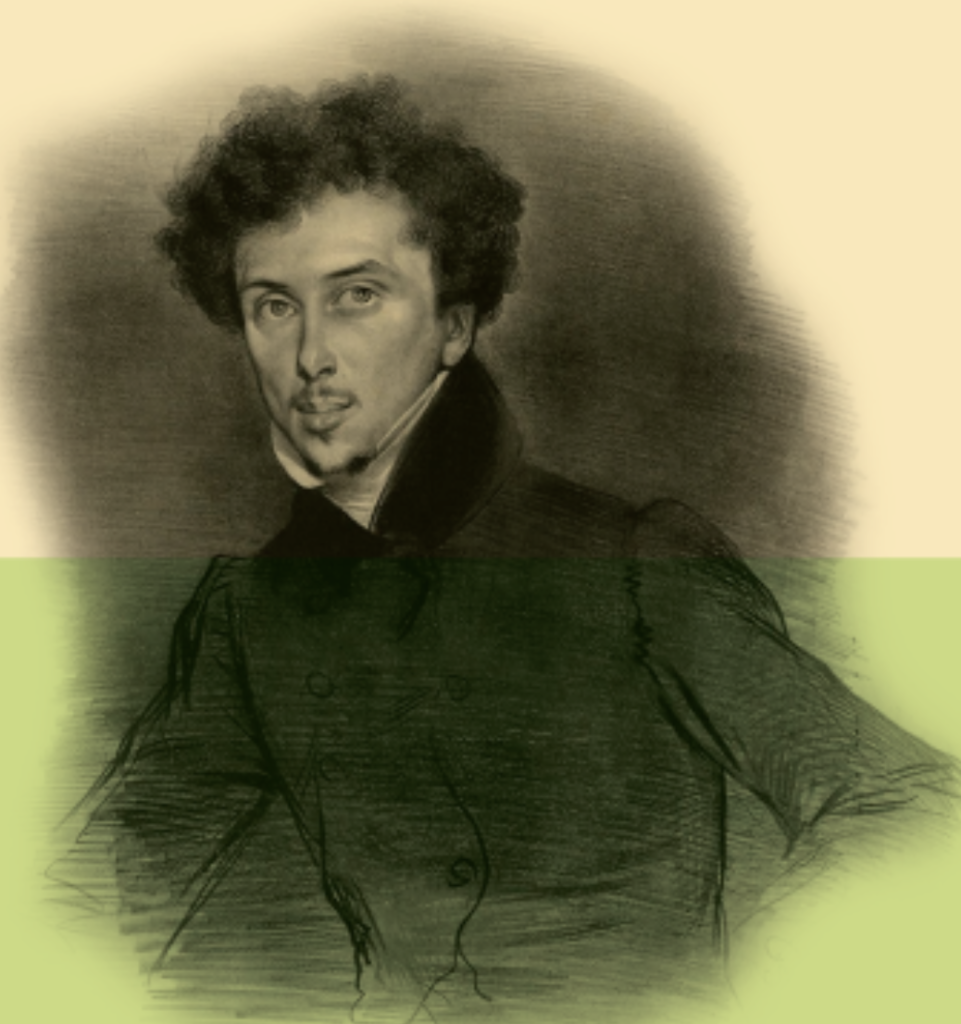
Alexandre Dumas was born on July 24, 1802, in Villers-Cotterêts. His father, Thomas Alexandre Davy de la Pailleterie, was a former slave who became a republican general before being dismissed by Napoleon Bonaparte. His mother, Marie-Louise-Elisabeth Labouret, was the daughter of an innkeeper in Villers-Cotterêts.
Youth in Villers-Cotterêts
Dumas lost his father at the age of four and was raised by his mother. Educated at the college of Abbé Grégoire, Alexandre spent more time honing his skills with weapons and hunting than attending classes. His literary education was largely self-taught, shaped by his reading. At the age of fourteen he was hired as a courier by a notary and he later became a notary clerk.
At seventeen year of age he met Adolphe Ribbing de Leuven, a peer who introduced him to poetry and theatre. Together, they began writing vaudevilles and dramas, dreaming of making their name in Paris.
The Parisian Stage
Dumas arrived in Paris in 1822 with only 53 francs to his name. Through former comrades-in-arms of his father, he obtained a position in the secretariat of the Duke of Orléans. Meanwhile, he continued writing and met literary figures in the salons of the time. Recognizing his literary shortcomings, he pursued a second, self-directed education, devouring books day and night.
His early attempts as an author were difficult: journals rejected his poems, and theatre directors barely glanced at the plays he co-wrote with Adolphe. The two friends eventually partnered with Pierre-Joseph Rousseau, who was better connected in theatrical circles, and together they wrote the vaudeville La Chasse et l’amour, which was successfully staged in Paris in September 1825.
On the evening of 10 February 1829 Alexandre Dumas, then largely unknown in literary circles, became a celebrity. That night marked the premiere of his play Henri III and His Court at the Comédie-Française. The play was a triumph and brought Dumas into the Romantic movement, alongside figures like Victor Hugo and Eugène Delacroix.
After the success of his tragedy Antony in 1831, he resigned from his position, determined to make a living from his writing. He went on to write many works, some more successful than others.
Thanks to his pen Dumas earned a modest fortune, which he spent freely. To maintain his luxurious lifestyle, he produced numerous plays that met with little public enthusiasm, as Romantic theatre was losing its audience.
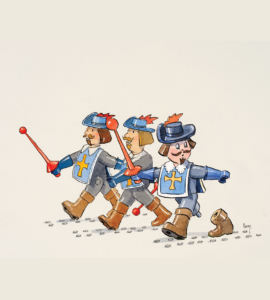
In the 1840s Alexandre Dumas shifted his literary focus and moved away from the theatre for a time. The moment had come for the novel—one novel in particular that would captivate generations of readers: The Three Musketeers.