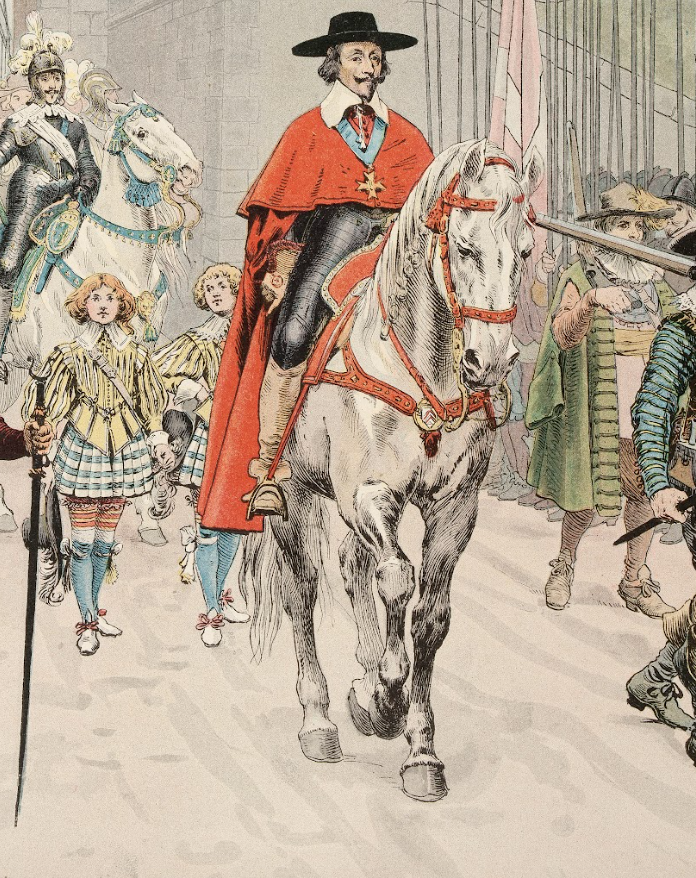
Born into a noble family, Armand Jean du Plessis initially prepared for a military career before entering the Church to take up the bishopric of Luçon. His keen intellect and political acumen allowed him to rise quickly through the ranks of power.
He first served Queen Mother Marie de’ Medici and then gained the trust of King Louis XIII, who appointed him as his chief minister in 1624. Richelieu’s mission was clear: to strengthen royal authority and weaken all powers that could challenge it.
He targeted the Protestants by besieging La Rochelle (1627–1628) and stripping them of their political privileges. He also repressed the high nobility with severity when it conspired against the crown. On the international stage, he pursued an ambitious policy to counter the power of the Habsburgs. Under his leadership the French army became a formidable force.
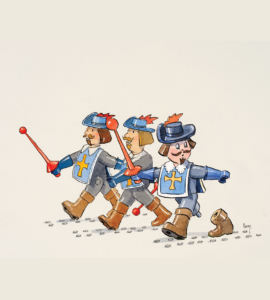
Richelieu made many enemies, particularly among the nobility, who resented his authority. He faced several plots and assassination attempts. King Louis XIII provided him with close protection, initially through a small cavalry unit, later expanded into a full personal guard. As early as 1631 Richelieu obtained the creation of military companies dedicated to his security. His personal guard, which at first consisted of a company of light horsemen, was replaced in 1633 by a foot regiment of Musketeers, recognizable by their red tabards marked with a white cross, who ensured his protection.
At the same time Richelieu built up a full military household, with several regiments actively engaged on battlefields, particularly during the Thirty Years’ War. This personal military force aroused suspicion, since maintaining a private guard was considered a royal privilege. Some consequently viewed Richelieu as a rival to the King, and pamphleteers and other critics painted him as a usurper surrounded by henchmen rather than by legitimate soldiers.
Richelieu also modernized the state administration, strengthening the role of the intendants, royal agents in the provinces. A patron of the arts and letters, he founded the French Academy (Académie française) in 1635. Worn down by illness he died in 1642, leaving behind a more centralized and powerful France. His political legacy was carried on by Cardinal Mazarin and culminated in the absolutism of Louis XIV.
Dumas' world
Concerned with his legacy, Richelieu could hardly have imagined that Alexandre Dumas would make him a famous literary figure in The Three Musketeers, appearing in nearly two-thirds of the novel’s chapters.
In Dumas’ world Richelieu is the archetype of the ruthless man of power, inspired both by 17th-century memoirists and the 19th-century Romantic imagination. He is portrayed as manipulating Louis XIII and orchestrating Buckingham’s assassination. Yet beyond the clichés, Dumas also presents a brilliant strategist—always well-informed, always one step ahead.
Dumas rarely depicts him in cardinal’s robes, instead dressing him as a man of action, sometimes in military uniform or Spanish riding gear. His political pragmatism and sense of timing are highlighted as he seizes on others’ weaknesses and turns former enemies into allies, including d’Artagnan. In Twenty Years After, Richelieu’s legacy is universally acknowledged—even by former adversaries like Queen Anne of Austria.