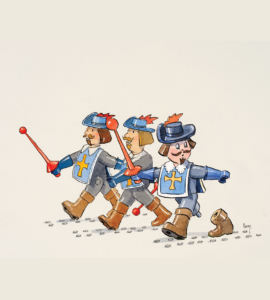
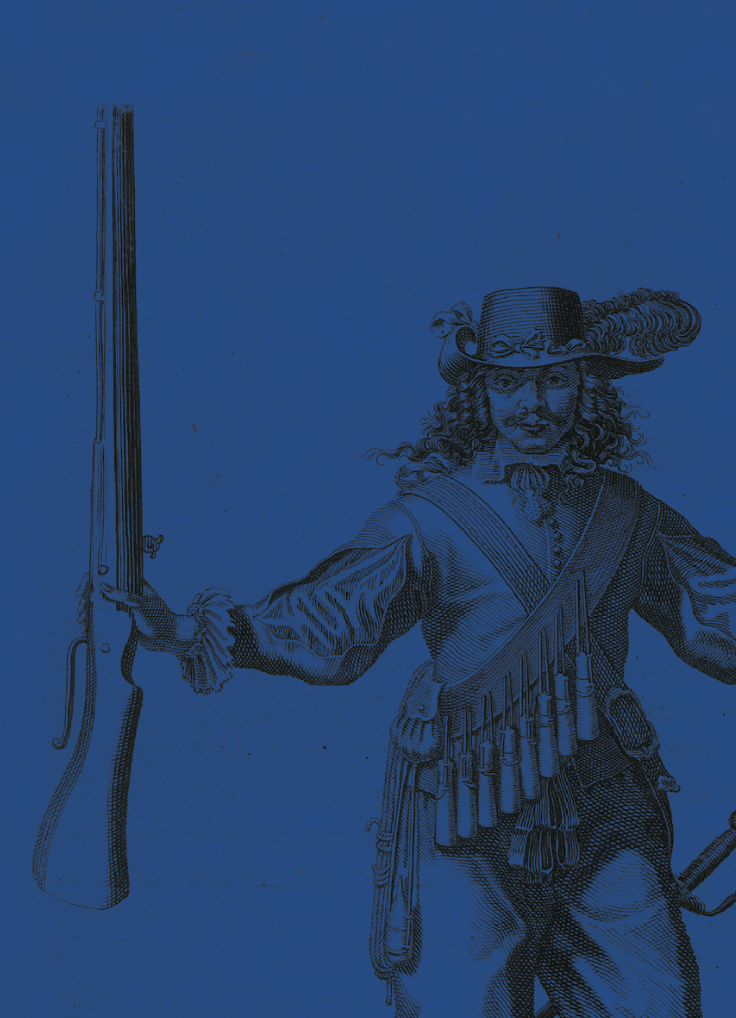
The King provided his Musketeers with only three essentials: lodging, a cassock (later replaced by a long sleeveless overcoat called a soubreveste), and a musket (later, a flintlock rifle).
The musket was the Musketeer’s standard weapon and it gave the corps its name. Under the Ancien Régime it was common to name military units after their primary arms. Thus the carabins du roi, created by Henry III and originally armed with carbines, became Musketeers when Louis XIII rearmed them with muskets in 1622.
This early matchlock musket weighed 6 to 8 kilograms and required many accessories to load. It was slow to reload, inaccurate and needed a fork rest—a wooden support planted in the ground to stabilize the shot. In other words Musketeers had to dismount to fire; it was an infantry weapon. By the late 17th century the Musketeers had replaced their matchlocks with flintlock rifles. By then, however, the name had stuck; they had already built a reputation that the King wished to preserve.
Yet Musketeers are most often pictured with sword in hand. Among the nobility—which made up the overwhelming majority of their ranks—firearms were seen as cowardly, being weapons that could be used from a distance. Upholding chivalric values, Musketeers preferred close combat, often discarding their muskets to charge under enemy fire. Numerous types of sword were used, especially for court or for duels.
As cavalrymen, Musketeers also carried a pair of pistols stored in holsters on their saddles.