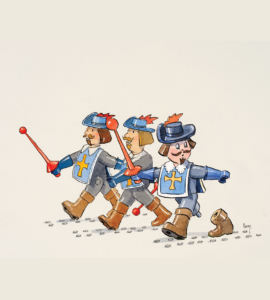
A Musketeer’s Day
A Musketeer’s daily routine was never strictly defined. His schedule depended entirely on the King’s orders, relayed each morning to the officers of both companies after mass.
These orders determined the missions for the next twenty-four hours. If the King had no need of their services, he would simply announce: “Nothing!” In that case, the young Musketeers continued their military training, while the more seasoned soldiers practiced in the battalion school (infantry) or the squadron school (cavalry). In the afternoon, they were granted free time but were expected to return by nightfall.
When the King travelled he would specify the meeting point and time each morning. His escort was composed of several military units:
- The gendarmes led the procession,
- The light cavalry closed the march,
- The Musketeers held the central position.
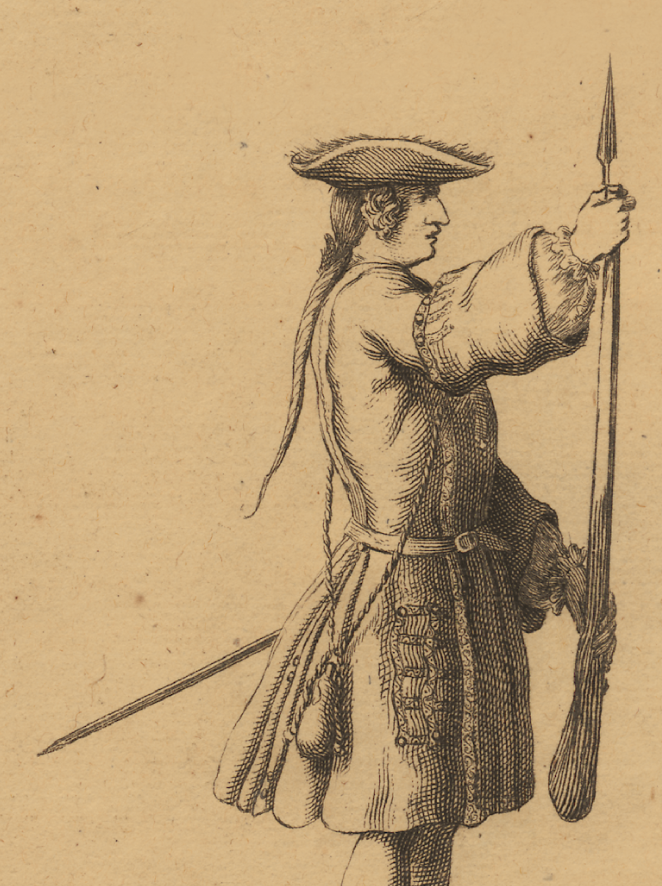
Four Musketeers rode ahead of the royal coach, muskets loaded, while the rest of the squadron cleared the road. The Musketeers were also called upon for law enforcement missions, often involving delicate tasks such as the arrest of Fouquet and Lauzun, or the suppression of unrest in Paris and Versailles.
In wartime the Musketeers accompanied the King and ensured his close protection, while during sieges they fought in the front lines alongside the mounted grenadiers.
Each year the King inspected his Musketeers in person at Versailles, where the companies arrived several days in advance and were housed in private mansions. This highly codified event, which served to showcase their discipline and precision, unfolded in three phases:
- Inspection on foot, during which the King questioned his soldiers with a register in hand.
- Mounted parade, where he examined harnesses and gear.
- Field maneuvers, closing the review under the King’s direct command.
This ceremonial exercise highlighted the prestige of the Musketeers, embodying absolute obedience and unwavering loyalty to the monarch.